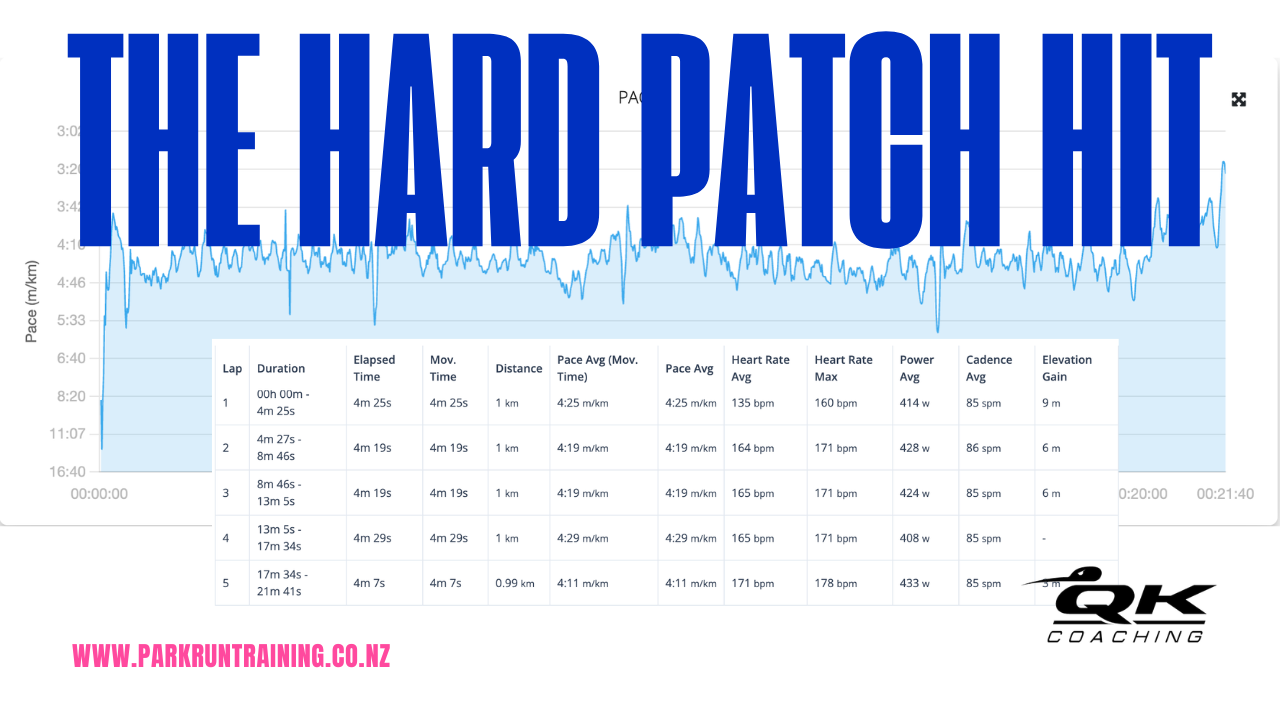
This week’s parkrun Progress Report looks back at my run from Whangārei parkrun #461 on 20 September 2025, where I ran 21:40 with splits of:
- 1st Km – 4:24
- 2nd Km – 4:19
- 3rd Km – 4:19
- 4th Km – 4:29
- 5th Km – 4:12
And honestly, the most important part of this run wasn’t the start.
It was what happened after the difficult patch.
A well-managed run
When I look back at this run now, what stands out most is that it was actually managed pretty well from a pacing perspective.
This wasn’t:
- reckless
- emotional
- or overly aggressive early
Instead, it was:
controlled early, composed through the middle, then fully committed late.
And for a 21-minute parkrun, that’s often the smarter way to race.
The course
Whangārei parkrun has an interesting layout.
The course:
- starts near the bridge
- climbs up and over it early
- heads out along the river
- doubles back
- then heads up the other bank before returning toward the finish area
It’s a course where rhythm matters.
And if you overcook the opening stages, the return leg can become very uncomfortable.
The first kilometre was deliberately restrained
The opening split was:
➡️ 4:24
But what makes this fascinating is the heart rate data.
Average HR in the first kilometre:
➡️ 135 bpm
That’s extremely controlled relative to the rest of the run.
Then suddenly:
- Km 2 HR jumps to 164 bpm
That’s a huge increase.
This wasn’t a gradual build.
This was:
“Okay… now the race actually starts.”
And honestly, I think that restraint early was one of the biggest positives of the run.
The middle of the run was very stable
Kilometres 2 and 3:
- 4:19
- 4:19
Heart rate:
- 164
- 165
Cadence:
- 86
- 85
Power:
- 428W
- 424W
That’s tidy running.
It suggests:
- good rhythm
- controlled effort
- efficient movement
- and no emotional surging
I was essentially sitting right around sustainable threshold effort through this section.
The 4th kilometre changed everything
Then came:
➡️ 4:29
This was the defining kilometre of the run.
Interestingly:
- heart rate stayed stable
- cadence stayed stable
…but:
- pace dropped
- power dropped to 408W
That’s important.
Because it suggests:
this wasn’t cardiovascular collapse.
It was more likely:
- muscular fatigue
- concentration drift
- mental discomfort
- or simply a tough patch in the race
Big difference.
The strongest part of the run came late
Then came the response.
Final kilometre:
➡️ 4:12
Heart rate:
➡️ 171 bpm
Power:
➡️ 433W
That was the highest power output of the entire run.
That matters.
Because it confirms:
the limiter wasn’t total exhaustion.
There was still another gear available.
And more importantly:
➡️ I was willing to access it once the run became uncomfortable.
That’s often what separates:
- solid parkruns
from: - genuinely strong ones.
Cadence stayed impressively stable
Cadence:
- 85
- 86
- 85
- 85
- 85
That’s really consistent.
It tells us:
- mechanics stayed intact
- fatigue didn’t significantly disrupt efficiency
- stride rhythm held together even during the difficult patch
That’s a positive sign of durability.
Power tells the real story
Power profile:
- 414W
- 428W
- 424W
- 408W
- 433W
That final kilometre being the highest power output of the run is fascinating.
Because it tells us:
➡️ there was still neuromuscular capacity left
➡️ pacing had been reasonably controlled early
➡️ and the body could still produce force late
That’s exactly what you want to see in a well-paced 5K.
The opportunity within the run
Looking back now, the obvious opportunity sits around:
➡️ the transition into the 4th kilometre.
Because if:
- power holds slightly better there
- or the mental re-engagement happens a little earlier
…then this probably moves from:
➡️ 21:40
toward:
➡️ low-21 or possibly sub-21 shape on the day.
The key lesson
A lot of runners think strong races are the ones where nothing hurts.
That’s rarely true.
The strongest runners are often:
the ones who can respond once the discomfort arrives.
That final kilometre was the biggest positive of this run.
The takeaway
The real strength in this run wasn’t the pace early — it was the ability to lift again once the race got uncomfortable.
Want help improving your own parkrun pacing?
If you’d like help pacing smarter, finishing stronger, and understanding your own performance trends, parkrun Kickstart is designed specifically for recreational runners wanting to improve over 5K.
👉 Join parkrun Kickstart here:
https://www.coachraytraining.co.nz/signup/parkrun-kickstart
And if you’d like your own run analysed in a future parkrun Progress Report:
👉 Apply here:
https://qwik-kiwi.kit.com/parkrun_progress_report
Ka kite anō — and all the best for your next parkrun.