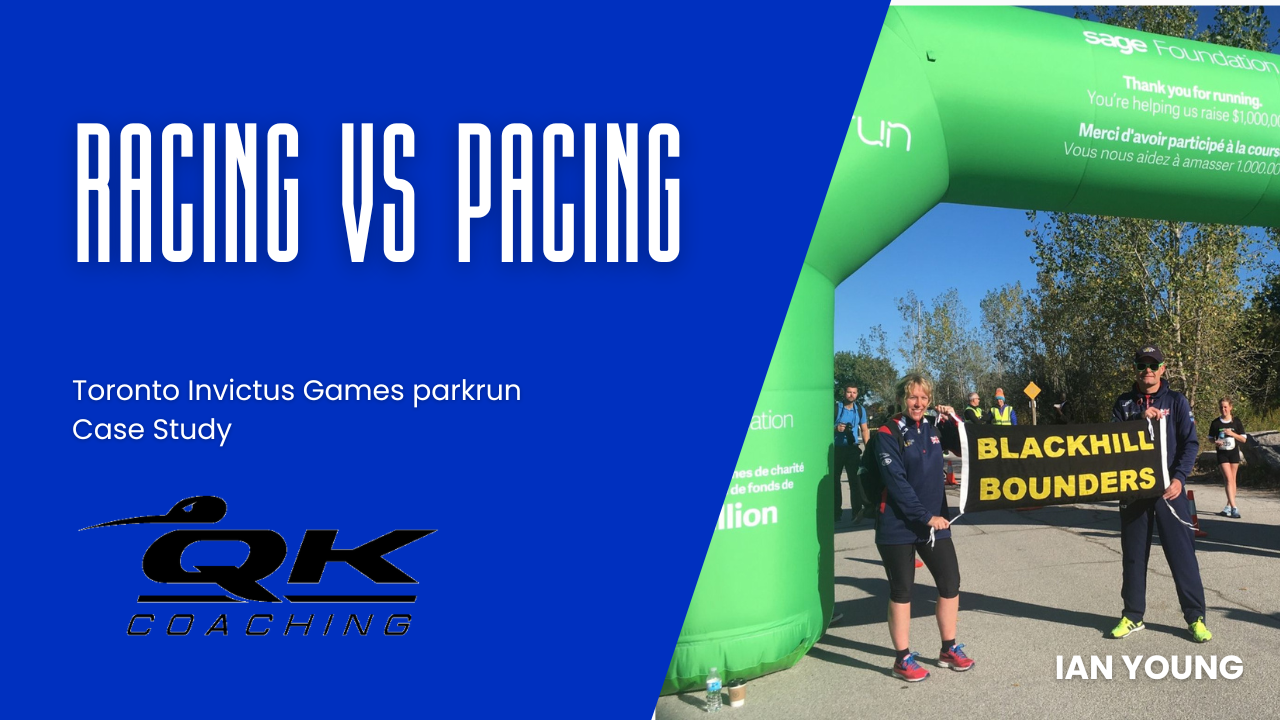
This week’s parkrun Progress Report takes us back to Toronto, where a special parkrun was staged during the Invictus Games as part of the event programme and sponsor activities.
It brought together athletes, support staff, families, friends, volunteers, and visitors. Among those on the start line was Ian Young, representing the United Kingdom Invictus Games team.
Ian and I both lined up that day.
I’ve previously written about my own performance at the same event, where I eventually managed to take the win late in the run. You can read that report here:
But this week is about Ian’s race — because when you look at the data and the context, it was a very impressive performance.
Important context: two weeks of competition already completed
Before we even look at the splits, one factor matters enormously.
Ian had already completed two weeks of competing at the Invictus Games prior to this parkrun.
That means he wasn’t arriving:
- fresh
- tapered
- fully recovered
- focused solely on a 5K PB attempt
He was coming off the back of a major multi-day international event environment, with all the physical and emotional load that comes with it.
That context makes this run even stronger.
The run at a glance
Ian’s watch measured the course at 4.76km, and he ran 18:28.
Splits:
- 1st Km – 3:41
- 2nd Km – 3:47
- 3rd Km – 3:51
- 4th Km – 4:05
- Final ~760m – ~4:00 pace
This is a classic race pattern:
- aggressive opening
- controlled middle
- fatigue and pressure late
- still fighting to the finish
Ian made the race happen
Some runners sit in and wait.
Ian didn’t.
He took the race on early and found himself leading through the first half of the event.
That opening kilometre in 3:41 tells us plenty.
It shows:
- confidence
- intent
- willingness to commit
- readiness to race rather than simply jog for a result
That’s the mark of a competitor.
The first three kilometres were strong
The progression of:
- 3:41
- 3:47
- 3:51
…is actually quite natural after a fast opener.
This isn’t reckless pacing.
It’s a runner setting a high tempo, then settling into the reality of race pace.
Up to 3km, Ian was still running very strongly.
The turning point of the race
The 4th Km came in at 4:05, the slowest split of the run.
This likely reflects a combination of:
- accumulated fatigue
- the cost of leading early
- tactical pressure as the race changed
- responding to moves rather than simply cruising
That’s what racing does.
A time trial is clean and smooth.
A race often isn’t.
And he still kept fighting
What I really like is the final section.
The last ~760 metres were still covered at around 4:00 pace.
That matters.
Because it shows Ian didn’t mentally switch off once the lead changed.
He stayed engaged. He kept competing. He pushed all the way to the line.
That says a lot about character.
Heart rate and cadence: strong mechanics under fatigue
Heart rate rose progressively:
- 170
- 176
- 184
- 180
- 183 finish
Cadence stayed excellent:
- 192
- 190
- 190
- 190
- 198 finish
That’s a huge positive.
Even under fatigue, mechanics stayed sharp and turnover remained high.
Often when runners tire, cadence drops and posture goes with it.
That didn’t happen here.
Why this run deserves respect
Without context, some people might simply look at:
Led early, got caught late.
But context matters.
Ian had already spent two weeks competing at the Invictus Games.
He still turned up, still raced hard, still led, and still fought to the finish in a fast field.
That’s impressive.
The lesson for parkrunners
There are two ways to approach a 5K:
Run for time
- smoother pacing
- measured effort
- even splits
Race for position
- tactical decisions
- surges
- responding to others
- willingness to hurt when it matters
Ian chose the second one.
And there’s real value in that.
What might have produced a faster time?
If this had been a solo run with fresh legs:
- slightly more conservative opener
- smoother middle kilometres
- no tactical disruptions
…he may well have run faster overall.
But that wasn’t the challenge on the day.
The challenge was to compete.
And he absolutely did that.
The takeaway
Sometimes the fastest run isn’t the bravest run.
Ian’s performance was brave, competitive, and honest.
That deserves recognition.
Want help with your own parkrun pacing or race strategy?
If you’d like to improve your pacing, race smarter, and finish stronger, parkrun Kickstart is designed to help you do exactly that.
👉 Join parkrun Kickstart here:
https://www.coachraytraining.co.nz/signup/parkrun-kickstart
And if you’d like your own run reviewed in a future parkrun Progress Report:
👉 Apply here:
https://qwik-kiwi.kit.com/parkrun_progress_report
Ka kite anō — and all the best for your next parkrun.