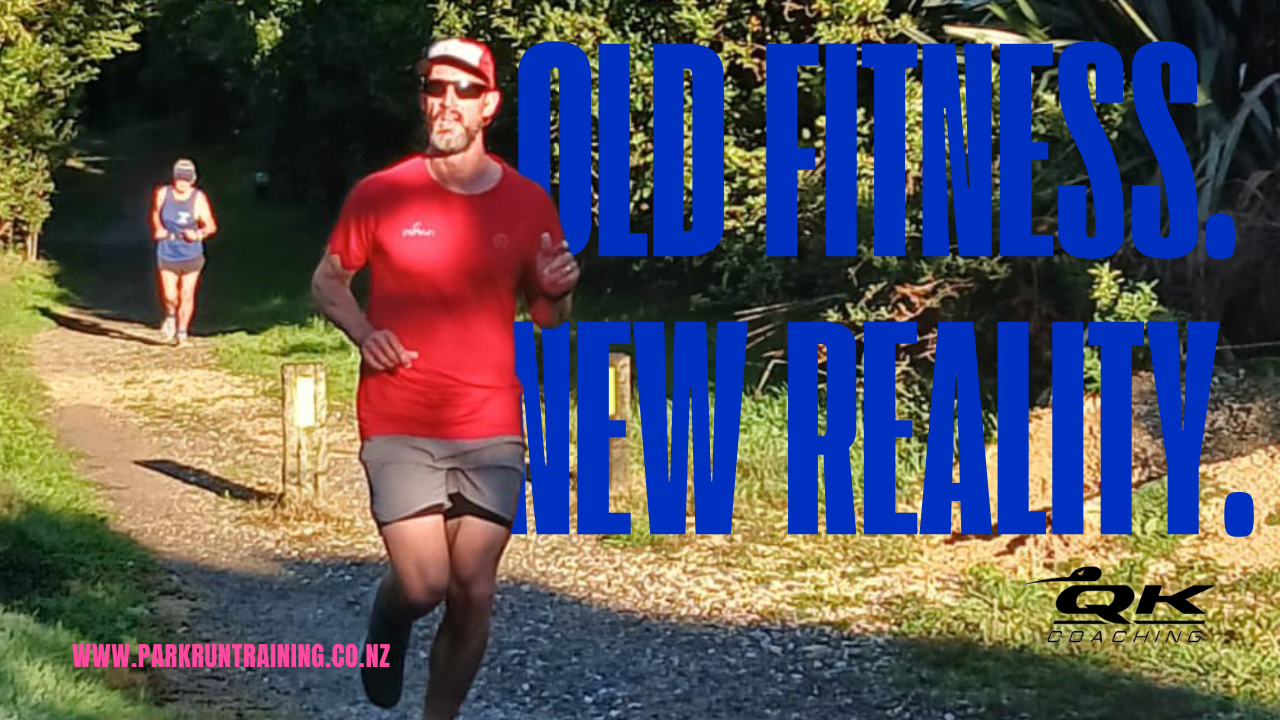
This week’s parkrun Progress Report comes from Paul Cannell and his run at Lost Lagoon parkrun #46 on 11 April 2026, where he ran 20:01 during his return from a long-term hamstring tendon injury.
And honestly?
Paul summed the run up himself pretty well before I even started analysing the data.
“I started way too ambitious, blew out and suffered throughout.”
There’s definitely truth in that.
But there’s also a lot more going on in this run than simply “bad pacing.”
Because underneath the slowdown are still clear signs of:
- competitiveness
- residual speed
- and a runner whose instincts still remember what 18:45 shape feels like
…even if the body hasn’t rebuilt the durability to support it yet.
The context matters
Before the injury, Paul had been running:
- 18:48 (PB)
- 18:44 (new PB)
- 18:46
- 18:45
over consecutive weeks.
That’s strong, consistent running.
But after suffering a hamstring tendon injury, the past 6–8 months had been heavily disrupted, with very little consistent training.
This run was effectively:
a comeback effort.
And comeback efforts are often where the brain and body temporarily disagree.
The opening kilometre changed everything
Splits:
- 1st Km – 3:34
- 2nd Km – 4:02
- 3rd Km – 4:03
- 4th Km – 4:13
- 5th Km – 4:25 pace
That opening kilometre is aggressive.
Very aggressive.
Not slightly optimistic.
Not “a touch enthusiastic.”
Aggressive.
Because a 3:34 opening kilometre projects toward:
➡️ low-18-minute shape
And right now, the body simply isn’t carrying:
- the training consistency
- durability
- or conditioning
to support that level of effort.
The “old fitness” trap
This is incredibly common for experienced runners returning from injury.
Mentally:
- they still know what fast running feels like
- they still identify with those performances
- and their instincts still remember those rhythms
But physiologically:
- the support systems underneath that speed aren’t fully rebuilt yet
So pacing decisions often get made from:
memory
rather than:
current readiness
That’s exactly what this run looks like.
The body corrected immediately
The drop from:
- 3:34 → 4:02
isn’t just normal slowing.
That’s correction.
The body essentially saying:
“We can’t sustain this today.”
And honestly, the fascinating part is what happened next.
He stabilised surprisingly well
After the correction:
- 4:02
- 4:03
That’s actually quite positive.
Because a full implosion would likely have looked more like:
- 4:02
- 4:20
- 4:40
Instead, Paul regained control and held things together reasonably well through the middle of the run.
That matters.
The fade late makes complete sense
Then:
- 4:13
- 4:25 pace late
This is where:
- accumulated fatigue
- early lactate cost
- injury protection
- and reduced durability
all begin catching up.
The body is now carrying:
- the price of the opener
- the consequences of inconsistent training
- and the limitations of the hamstring recovery
That’s a hard combination to fight.
The heart rate data tells the story clearly
Heart rate:
- 164
- 155
- 164
- 164
- 169 finish
That drop from:
➡️ 164 → 155
after the opening kilometre is incredibly revealing.
It strongly suggests:
the body had to back off significantly after the opening effort just to recover.
That aligns perfectly with the pacing data.
Cadence reveals something even more interesting
Cadence progressively dropped:
- 178
- 170
- 168
- 166
That reflects:
- fatigue
- loss of elasticity
- declining efficiency
- and likely some subconscious hamstring protection
But then something changes around 4.4km.
Cadence suddenly rises:
➡️ 180–182 SPM late.
That’s the really interesting moment.
Because it tells us:
the competitive instinct was still there.
Even after suffering through the run, Paul still found another gear late.
That says a lot mentally.
This wasn’t a runner who “can’t run fast anymore”
That’s the important distinction.
This wasn’t:
a lack of ability
It was:
a mismatch between ambition and current durability.
Big difference.
The speed instincts are still there.
Now the challenge becomes rebuilding:
- consistency
- durability
- and confidence underneath them again.
The lesson for experienced runners
This run is a really good reminder that comeback fitness often lags behind remembered fitness.
And that’s normal.
The body rebuilds in layers:
- movement confidence
- rhythm
- aerobic durability
- repeatability
- race resilience
The hardest part is often accepting that the body is currently in a different place than the mind remembers.
The takeaway
The body always tells the truth about current fitness — even when the mind remembers something faster.
Want help improving your own parkrun pacing?
If you’re rebuilding after injury, chasing a PB, or trying to understand your own pacing better, parkrun Kickstart is designed to help recreational runners train smarter and race more effectively.
👉 Join parkrun Kickstart here:
https://www.coachraytraining.co.nz/signup/parkrun-kickstart
And if you’d like your own run analysed in a future parkrun Progress Report:
👉 Apply here:
https://qwik-kiwi.kit.com/parkrun_progress_report
Ka kite anō — and all the best for your next parkrun.