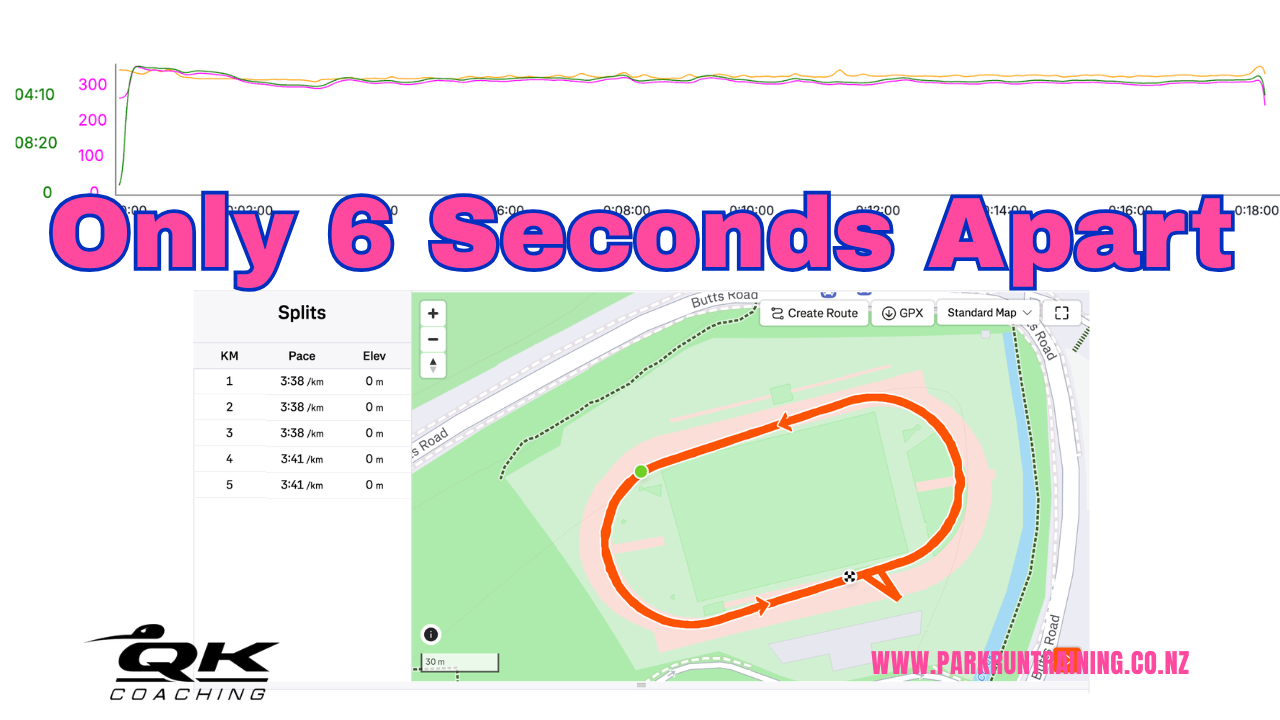
This week’s (not) parkrun Progress Report comes from Jess Bray and her performance in the Otago 5,000m Championships, where she ran an outstanding 18:12 to claim the Otago Under-20 Women’s title.
Now, on paper, an 18:12 is already an impressive result.
But honestly?
The most impressive part wasn’t the time.
It was how little her pace changed across the entire 5,000 metres.
When I analysed the data, I wasn’t looking at an athlete hanging on for dear life.
I was looking at an athlete racing.
And there’s a difference.
Track Racing Is Different
An 18:12 on the track is a very different challenge from an 18:12 at parkrun.
There are:
- no GPS shortcuts
- no downhill sections
- no chasing Strava segments
- no weaving around other participants on shared pathways
Instead, there are:
12½ laps of honest running.
Every lap counts.
Every mistake gets exposed.
Every pacing decision matters.
And Jess handled that challenge exceptionally well.
Championship Context Matters
Jess was the only athlete in the Under-20 Women’s category.
However, this wasn’t a separate race.
She was competing in an open field that included:
- senior women
- senior men
- masters athletes
And despite being one of the youngest athletes on the track, she finished:
🏆 Otago U20 Women’s Champion
🏅 4th Female Overall
That’s a performance worth celebrating.
Especially considering she had only recently completed Challenge Wanaka, meaning her preparation included relatively little specific 5,000m speed work.
The Pacing Was Outstanding
Jess’s kilometre splits were:
- 3:38
- 3:37
- 3:38
- 3:43
- 3:38
The difference between her fastest and slowest kilometre?
Just six seconds.
Across an 18-minute race, that’s exceptional.
Many athletes chasing a fast 5,000m open aggressively and then spend the second half trying to survive.
Jess didn’t.
She stayed controlled early and gave herself the opportunity to compete right through to the finish.
The Fourth Kilometre Tells The Story
The fourth kilometre stands out.
At 3:43, it was the slowest split of the race.
But that’s exactly where I would expect the race to get difficult.
In track racing, the hardest part is often not:
- the first kilometre
- or the final kilometre
It’s the kilometre immediately before the finishing move begins.
The race has become uncomfortable.
The finish still feels a long way away.
The adrenaline hasn’t arrived yet.
That’s where races are won and lost.
Jess absorbed that section brilliantly.
The Final Kilometre Was The Most Impressive
What happened next is what really caught my attention.
After the slight slowdown:
➡️ 3:38 for the final kilometre
That tells us:
- she didn’t crack
- she didn’t unravel
- she didn’t run out of fitness
Instead, she found another gear.
That is a hallmark of a quality racer.
The Heart Rate Data
The heart rate data included a couple of obvious anomalies:
- 137 bpm
- 186 bpm
- 194 bpm
- 195 bpm
- 161 bpm
The first kilometre is almost certainly affected by heart rate lag.
The final kilometre appears to contain a recording error or sensor dropout.
The important numbers are in the middle of the race:
- 186 bpm
- 194 bpm
- 195 bpm
These tell us Jess was operating right at race intensity.
This wasn’t conservative running.
This was proper hard racing.
The Power Data Is Beautifully Controlled
Normalised Power:
- 315W
- 306W
- 307W
- 302W
- 301W
I love this.
Despite:
- accumulating fatigue
- increasing physiological stress
- championship pressure
the power barely moved.
That tells me Jess was managing effort exceptionally well.
She wasn’t chasing pace.
She was racing the event.
And that’s exactly what successful track athletes do.
The Cadence Data Is Exceptional
Cadence:
- 180 spm
- 184 spm
- 186 spm
- 188 spm
- 187 spm
This may actually be the most impressive metric of the entire race.
Notice what happened as fatigue increased.
Her cadence didn’t fall.
It rose.
Most runners:
- overstride
- lose rhythm
- become less efficient
Jess did the opposite.
Then, in the finishing straight, her cadence peaked at:
➡️ 204 spm
That suggests there was still:
- competitiveness
- aggression
- and finishing speed available
when it mattered most.
She Never Lost Her Rhythm
For me, that’s the biggest takeaway.
The pace varied slightly.
The race became difficult.
Fatigue accumulated.
But the rhythm never disappeared.
The mechanics remained strong.
The cadence stayed high.
The power remained controlled.
And she still finished aggressively.
That’s what good racing looks like.
The Key Lesson
A lot of runners can run fast when they feel good.
The best runners keep racing well when they’re hurting.
Jess demonstrated exactly that in this race.
She didn’t simply run 18:12.
She raced 18:12.
And that’s a very important distinction.
Overall Assessment
This was:
A highly disciplined championship 5,000m performance built on excellent pacing, outstanding rhythm, and the ability to respond when the race became uncomfortable.
The hallmark of a good track runner isn’t how fast they start.
It’s how well they hold their rhythm when everyone else starts hurting.
And Jess did that exceptionally well.
Want Help Improving Your Own parkrun or 5K?
If you’d like help improving your pacing, race execution, and overall 5K performance, parkrun Kickstart is designed specifically for recreational runners wanting to run smarter and faster.
👉 Join parkrun Kickstart:
https://www.coachraytraining.co.nz/signup/parkrun-kickstart
And if you’d like your own run analysed in a future parkrun Progress Report:
👉 Apply here:
https://qwik-kiwi.kit.com/parkrun_progress_report
Ka kite anō, and all the best for your next race.