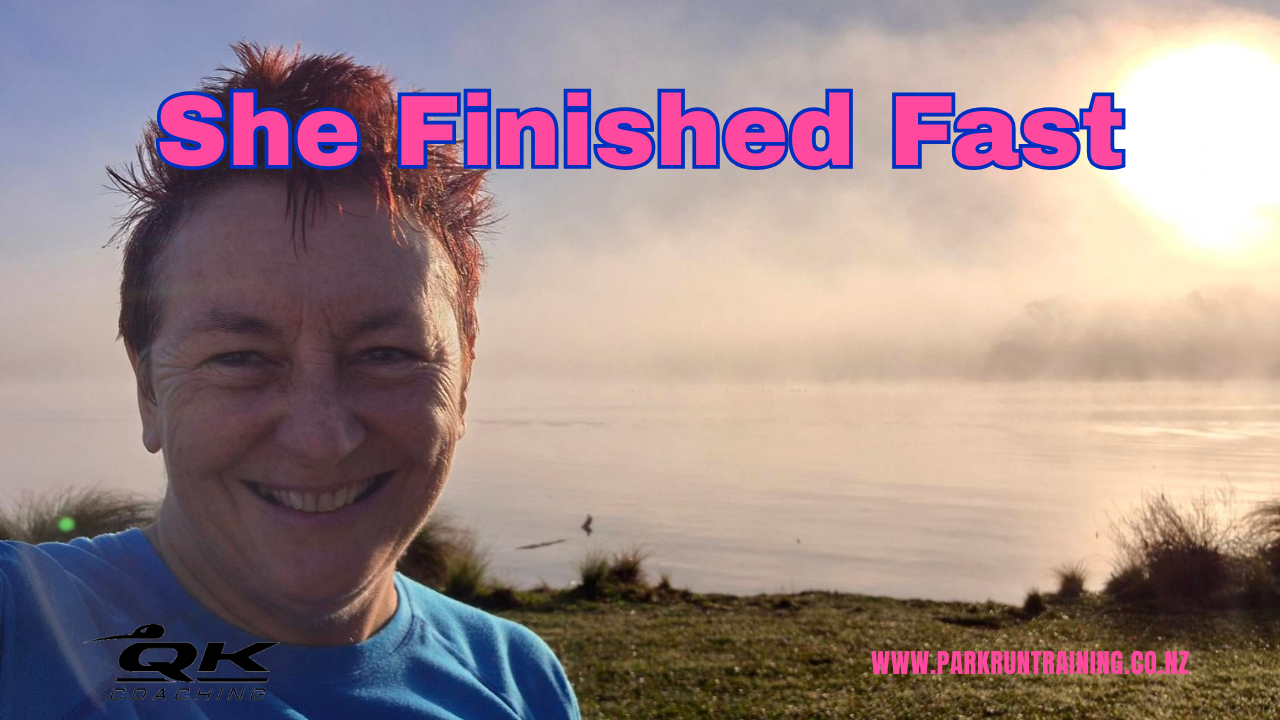
This week’s parkrun Progress Report features Tanya Winter and her run at Hamilton Lake parkrun #625, where she finished in 27:24.
At first glance, this might look like a fairly even run with a conservative start.
But when you dig into the splits, a much more interesting story appears.
This wasn’t a runner who was simply trying to survive the final kilometre.
This was a runner who managed her effort well enough to finish with her fastest kilometre of the day.
And that’s a habit worth developing.

The pacing tells the story
Tanya’s kilometre splits were:
- 1st Km – 5:40
- 2nd Km – 5:29
- 3rd Km – 5:26
- 4th Km – 5:31
- 5th Km – 5:06
Hamilton Lake is a very flat course, with only negligible elevation changes throughout the run, so these splits are almost entirely a reflection of pacing rather than terrain.
What immediately stands out is the progressive nature of the run.
Rather than charging away from the start, Tanya allowed herself to settle into a rhythm before gradually increasing the pace.
The first kilometre was controlled
Some runners might look at the opening 5:40 and think she gave away valuable time.
I’m not so sure.
Because the remainder of the run suggests something very different.
Instead of spending the race trying to recover from an overly ambitious start, Tanya steadily built into the effort.
That’s often the sign of a runner who understands their body and is prepared to race with patience rather than emotion.
The middle of the race stayed consistent
The next three kilometres came in at:
- 5:29
- 5:26
- 5:31
Five seconds either side of each other isn’t much at all.
That’s consistent pacing.
There wasn’t a dramatic slowdown.
There wasn’t a collapse.
There wasn’t any sign that Tanya had gone out beyond what she could sustain.
She simply maintained a comfortable but purposeful rhythm.
The final kilometre is the standout
The biggest positive comes right at the end.
➡️ 5:06
That’s a huge finish.
Compared with the fourth kilometre, Tanya found another 25 seconds over the final kilometre.
On a flat course, that’s significant.
It tells me she still had both the physical and mental capacity to lift the pace when the finish line came into sight.
That’s exactly what you want to see.
Stable cadence tells another positive story
Although heart rate data wasn’t available, the cadence numbers provide another useful insight.
Cadence remained remarkably consistent throughout:
- 174 spm
- 172 spm
- 170 spm
- 172 spm
- 170 spm
Despite increasing her speed during the run, Tanya didn’t dramatically change her running rhythm.
That’s encouraging because it suggests she increased her pace while maintaining efficient mechanics, rather than overstriding or forcing the effort.
Many runners lose rhythm as fatigue builds.
Tanya maintained hers.
What can we learn?
The biggest opportunity probably sits in the opening kilometre.
Given how strongly Tanya finished, there may be scope over time to begin slightly faster while still preserving that excellent finish.
Perhaps bringing the first kilometre closer to 5:30–5:35 could unlock another improvement.
But if I had to choose between:
- starting too fast and fading
or
- starting patiently and finishing strongly
I’d choose Tanya’s approach every time.
It’s far easier to teach someone to be slightly more assertive early than it is to teach them how not to blow up halfway through a run.
The biggest takeaway
What impressed me most wasn’t the finishing time.
It was the confidence to stay patient.
Many runners become obsessed with their opening kilometre.
Tanya focused on the finish.
As a result, she crossed the line still running well while many runners around her were probably slowing dramatically.
That’s smart racing.
Final thoughts
This was a well-executed parkrun built on:
- controlled early pacing
- consistent middle kilometres
- efficient running mechanics
- and an outstanding final kilometre.
The biggest lesson from Tanya’s run is simple:
Your fastest kilometre doesn’t have to be your first kilometre. Quite often, your biggest PBs come when your fastest running happens at the end, not the beginning.
That’s exactly what Tanya demonstrated at Hamilton Lake.
Ready to finish your next parkrun stronger?
If you’d like to learn how to pace your parkruns more effectively, finish with confidence, and achieve more personal bests, parkrun Kickstart is designed specifically for recreational runners looking to improve over 5K.
👉 Join parkrun Kickstart here:
https://www.coachraytraining.co.nz/signup/parkrun-kickstart
If you’d like your own parkrun or 5K analysed in a future parkrun Progress Report, you can apply here:
👉 https://qwik-kiwi.kit.com/parkrun_progress_report
Ka kite anō, and I’ll see you at your next parkrun.