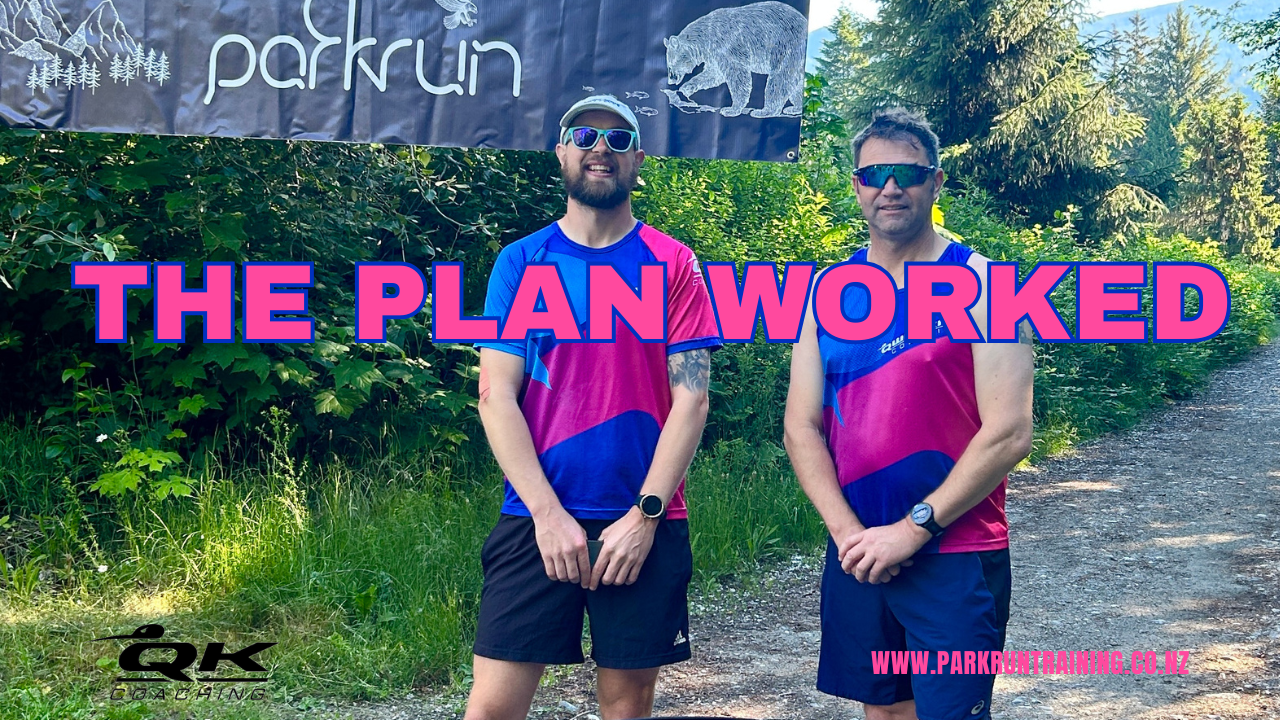
Winning a parkrun is always satisfying.
But this week’s parkrun Progress Report isn’t really about winning.
It’s about race execution.
This report looks back at my run at Mamquam Spawning Trail parkrun #49 in Squamish, British Columbia, where I crossed the line first in 24:09. While the result was a pleasant surprise, the real success came from something I’d planned before the start.
I wasn’t trying to run a personal best.
I was trying to execute a pacing experiment.
And it almost went exactly to plan.
This is Part 1 of a two-part series. In Part 2, I’ll return to the same course two weeks later to see whether I could improve on this strategy.

A Beautiful Course For A Pacing Experiment
Mamquam Spawning Trail parkrun takes place alongside the Mamquam River through a network of flat gravel trails surrounded by mountains and salmon spawning channels. The course is fast, scenic and well suited to testing pacing strategies because there are very few significant hills to influence the result.
Before the start I set myself one simple goal.
Each kilometre would be 10 seconds faster than the one before it.
The planned splits were:
- 5:00
- 4:50
- 4:40
- 4:30
- 4:20
The challenge wasn’t running fast.
The challenge was staying patient.
How Close Did The Plan Come?
The actual splits were:
- 5:14
- 4:50
- 4:41
- 4:38
- 4:29
Was it perfect?
No.
Was it successful?
Absolutely.
The opening kilometre ended up slightly slower than planned, but from there the race unfolded almost exactly as I had hoped.
Every kilometre became progressively quicker.
That’s much harder than it sounds.
Many runners talk about wanting to negative split.
Very few actually achieve it.
The Heart Rate Told The Story
Average heart rate climbed steadily throughout the run:
- 135 bpm
- 152 bpm
- 160 bpm
- 167 bpm
- 170 bpm
- 173 bpm to the finish
This is almost textbook.
Rather than spiking early and trying to hang on, the effort increased gradually as the race progressed.
That tells me the pacing was controlled rather than emotional.
Power Built Beautifully
Perhaps my favourite metric from this run was power.
Average power increased almost perfectly throughout the race:
- 356 W
- 369 W
- 390 W
- 393 W
- 401 W
before finishing at 414 W over the final metres.
There were no unnecessary surges.
No big fluctuations.
Just a smooth increase in workload from start to finish.
That is exactly what I was hoping to achieve.
The Most Boring Metric Was Also The Best
Cadence was remarkably stable:
- 85 spm
- 85 spm
- 86 spm
- 86 spm
- 86 spm
Nothing really changed.
That’s a good thing.
Rather than increasing turnover, I simply applied a little more force while maintaining the same running rhythm.
Consistent mechanics often lead to consistent performances.
Winning Wasn’t The Goal
Although I won the event, that wasn’t what determined how I raced.
I wasn’t chasing other runners.
I wasn’t responding to attacks.
I simply followed my own pacing plan.
Ironically, I think that’s one of the reasons I ended up winning.
By focusing on my own execution instead of reacting to everyone else, I avoided wasting energy early in the race.
Where Could It Have Been Better?
Every race leaves something to learn.
For me, the opportunity was actually the opening kilometre.
The 5:14 wasn’t a mistake.
But looking back, I think I still had enough in reserve to have opened closer to 5:05–5:08, or even my original goal of 5:00, without compromising the progressive nature of the run.
That may have brought the finishing time closer to 24:00, while still preserving the same controlled execution.
That’s the exciting part of analysing your own races.
The data helps shape the next experiment.
The Biggest Lesson
The most satisfying part of this run wasn’t crossing the finish line first.
It was seeing every key metric tell the same story.
- Pace increased.
- Heart rate increased.
- Power increased.
- Cadence remained stable.
Everything pointed towards one conclusion.
The pacing strategy worked.
Don’t be afraid to start under control. A patient first kilometre often gives you the opportunity to run your strongest final kilometre—and that’s where races are frequently won.
Part 2 Is Coming…
Two weeks later I returned to Mamquam Spawning Trail parkrun.
Armed with everything I’d learned from this race, I wanted to answer one question.
Could I improve the pacing strategy?
Or would this first attempt remain the better execution?
You’ll find out in Part 2.
Want To Improve Your Own parkrun?
If you’d like to become a stronger, smarter parkrunner, parkrun Kickstart is designed to help you train more effectively, pace your races with confidence, and achieve more personal bests.
👉 Join parkrun Kickstart:
https://www.coachraytraining.co.nz/signup/parkrun-kickstart
If you’d like your own parkrun or 5K analysed in a future parkrun Progress Report, you can apply here:
👉 https://qwik-kiwi.kit.com/parkrun_progress_report
Ka kite anō, and I’ll see you in Part 2.