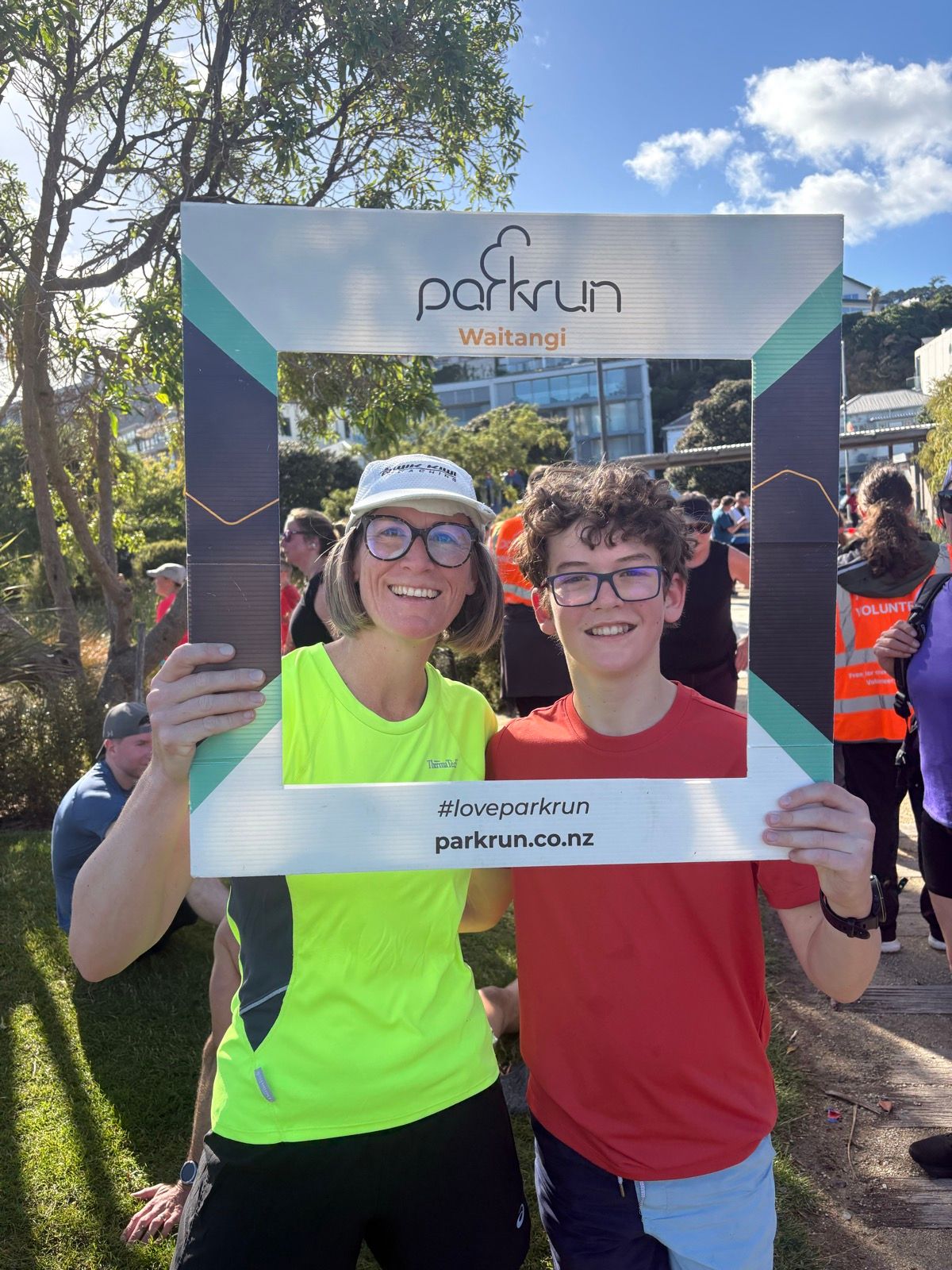
Kelly Lilley’s parkrun Progress Report: Waitangi parkrun
One of the clearest signs of a well-executed parkrun is not how fast you start, but how strong you finish. Kelly Lilley’s recent run at Waitangi parkrun is a textbook example of smart pacing, emotional control, and confidence building across the full 5km.
In this parkrun Progress Report, we’re breaking down why Kelly’s fastest kilometre came at the very end of the run — and how other runners can apply the same principles to their own parkrun performances.
Course context: Waitangi parkrun
Waitangi parkrun is a scenic, flat, two-lap course around Wellington’s waterfront. The run starts in Waitangi Park, heads out along the water’s edge, turns just past Shed 6, loops the park, and then repeats the same circuit before finishing close to where runners began.
Because the terrain is flat and predictable, pacing errors tend to be exposed very clearly. There’s nowhere to hide if you start too fast — and plenty of opportunity to finish strongly if you manage your effort well.
Kelly’s splits: calm, controlled, then committed
Kelly’s kilometre splits were:
- 4:57
- 4:54
- 4:59
- 4:58
- 4:40
What jumps out immediately is the exceptional consistency across the first four kilometres. The spread between her slowest and fastest split in that opening 4km is less than five seconds.
That tells us a lot.
Kelly wasn’t reacting emotionally to the start. She didn’t surge with the pack, didn’t chase early runners, and didn’t burn matches trying to “bank time.” Instead, she settled quickly into a sustainable rhythm that she could comfortably hold.
Then came the key moment: a decisive final kilometre, run 15–20 seconds faster than her average pace.
Why finishing fast matters
Kelly’s fastest kilometre coming at the end tells us three important things:
- She regulated effort early – Energy was preserved rather than spent too soon.
- Confidence grew during the run – Each kilometre reinforced that she was in control.
- The surge was a choice, not desperation – The final push was intentional, not forced.
This is the opposite of the classic parkrun mistake, where runners open too hard, fade gradually, and hang on grimly to the finish.
Kelly’s run shows what happens when pacing discipline meets fitness: you earn the right to accelerate late.
Cadence, heart rate, and effort trends
Supporting the pacing data were Kelly’s underlying metrics:
- Heart rate rose gradually throughout the run, rather than spiking early
- Cadence stayed high and consistent, lifting slightly toward the finish
- Running power increased late, matching the faster pace
All signs of a runner who stayed within herself early and let the effort build naturally.
Could she go faster next time?
Ironically, runs like this often raise the most interesting coaching question:
If Kelly finished with so much in reserve, could she go faster overall?
Possibly — but not by trying harder.
Two realistic options stand out:
- Starting just 5 seconds per kilometre quicker, while keeping the same controlled feel
- Bringing the final surge forward slightly, committing from ~1.5km to go instead of waiting for the last kilometre
Either approach redistributes effort rather than increasing it — a key distinction for sustainable improvement.
The takeaway for your next parkrun
Kelly’s Waitangi parkrun is a brilliant example of how to race smart:
- Calm, controlled opening kilometres
- Stable rhythm through the middle of the run
- A confident, intentional push to the finish
If you want to run faster at parkrun, don’t focus on “trying harder.” Focus on managing effort better.
That’s where the biggest gains usually come from.
Want help applying this to your own parkrun?
🚀 parkrun Kickstart: 4 Weeks to Your Best Saturday Run Yet
If you’re new to parkrun, returning after a break, or feel like you’re guessing your way through each Saturday, parkrun Kickstart is the perfect place to begin.
This 4-week plan is designed to help you build consistency, learn how to pace yourself properly, and arrive at parkrun feeling prepared rather than pressured. You’ll get clear, structured sessions, simple guidance you can actually follow, and a framework that teaches you how to run smarter, not just harder.
parkrun Kickstart takes the uncertainty out of your training so you can line up each Saturday with confidence, control your effort, and finish stronger than you started.
👉 Join parkrun Kickstart and lay the foundations for better parkruns — this month and beyond.
https://www.coachraytraining.co.nz/signup/parkrun-kickstart
And if you’d like a personalised breakdown of your parkrun — just like this one — you can apply for your own parkrun Progress Report below:
👉 https://qwik-kiwi.kit.com/parkrun_progress_report
Ka kite anō, and all the best for your next parkrun.