This week’s (not) parkrun Progress Report is Part 2 of a two-part series looking at Pip’s 5K time trial progression.
If you haven’t read Part 1 yet, you can find it here:
👉 https://wp.me/pgV9w4-g9
In that run, Pip clocked 32:24, and the key takeaway was clear:
she started too fast… and paid for it later.
Four weeks on, she repeated the same 5K time trial.
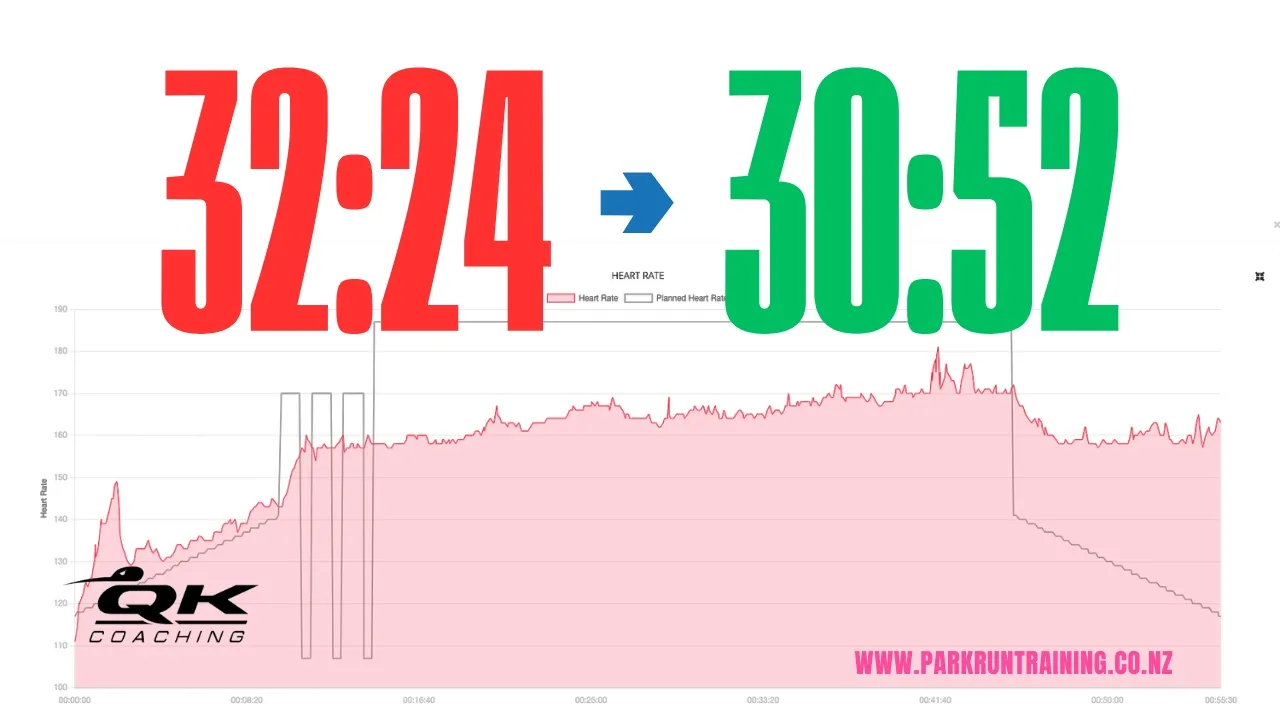
This time, she ran 30:52.
That’s an improvement of over 90 seconds.
But the real story isn’t just the time.
It’s how she ran it.
The run at a glance
Mile splits:
- 1st Mile – 9:57
- 2nd Mile – 9:57
- 3rd Mile – 9:53
- Final ~170m – consistent finish
Compare that to Part 1:
- 9:45 → 10:17 → 11:14
This is a completely different run.
The biggest change: control
In Part 1:
- the run was front-loaded
- effort was too high early
- fatigue dictated the rest
In Part 2:
- pacing is controlled
- effort is distributed evenly
- the run stays consistent from start to finish
That’s the difference.
The pacing transformation
This is where most of the improvement comes from.
Instead of:
➡️ losing time every mile
She is now:
➡️ holding pace across the entire run
That alone accounts for a large portion of the 90-second gain.
The heart rate tells the story
Part 1:
- heart rate flat → slightly decreasing
- body backing off
Part 2:
- 161 → 165 → 170 → steady
That’s exactly what we want.
A gradual rise in heart rate tells us:
- effort is controlled early
- the system is building into the run
- fatigue is managed, not forced
Aerobic efficiency: the real win
This is the key insight from this run.
Pip is now:
- running faster
- at a similar or lower early heart rate
- with less breakdown
That means:
She’s producing more speed for the same effort.
That’s improved aerobic efficiency.
And that comes from:
- consistent training
- repeatable sessions
- building endurance
Cadence: small shift, big impact
Part 1:
- cadence declined across the run
Part 2:
- 83 → 85 → 86
Instead of breaking down:
➡️ she finds rhythm
This tells us:
- movement is more efficient
- fatigue is better managed
- she’s running with more control
The middle of the run: where it was won
In Part 1, this is where everything fell apart.
In Part 2:
- the pace holds
- the effort stays consistent
- the rhythm is maintained
That’s the difference between:
- surviving a run
and - executing a run
What caused the improvement
This isn’t random.
This is the result of:
- consistent training
- improved aerobic fitness
- learning how to pace a 5K
- building confidence in effort
Not:
- a one-off effort
- or pushing harder
The key lesson
She didn’t run harder — she ran smarter.
That’s what unlocked the performance.
What this means going forward
The most exciting part?
This still wasn’t an all-out effort.
There is still room to:
- push slightly earlier
- lift the final segment
- and continue building confidence
That points toward:
➡️ a realistic move toward sub-30
The bigger picture
This is what progress actually looks like:
- not dramatic changes in fitness
- but better use of the fitness you already have
From Part 1 to Part 2, the transformation is clear:
Better pacing → better result
Want help with your own pacing?
If you feel like you’re leaving time out on the course — or you’re not sure how to pace your parkrun or 5K — I can help.
👉 Apply for your own parkrun Progress Report here:
https://qwik-kiwi.kit.com/parkrun_progress_report
Or if you want a structured plan to improve your pacing and consistency:
👉 Join parkrun Kickstart here:
https://www.coachraytraining.co.nz/signup/parkrun-kickstart
Ka kite anō — and all the best for your next parkrun.