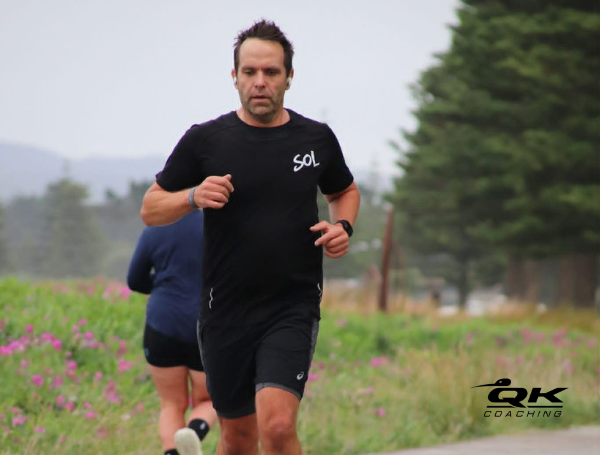
This week’s parkrun Progress Report comes from a school friend of mine, Greg Saunders, and his run at Gisborne parkrun #375 on 21 March 2026, where he clocked 26:57.
On paper, it’s his fastest parkrun of the year.
But the real story here isn’t the time.
It’s what this run tells us about a comeback.
The context matters
Greg is returning from a year disrupted by a knee injury.
He’s only recently:
- rebuilt some consistency
- started introducing higher-intensity work again
- begun to trust his body under load
His goal is clear:
Get back under 25 minutes consistently
His PB sits at 24:49, set about 12 months ago.
So this run sits right in that early-to-mid comeback phase.
And that’s exactly how it reads.
The run at a glance
Strava measured the run at 4.73km, but the splits still give us a clear picture:
- 1st Km – 5:28
- 2nd Km – 5:34
- 3rd Km – 5:29
- 4th Km – 5:35
- Final ~730m – 5:09/km pace
That’s a really tidy pacing profile.
Four kilometres all sitting within a few seconds of each other…
…and then a clear lift to finish.
The smartest part of this run
What I like most is the restraint early.
There’s no:
- charging the first kilometre
- chasing pace that isn’t sustainable
- emotional reaction to other runners
Instead, Greg settles into a rhythm straight away.
That’s not always easy when you’re coming back from injury.
There’s often a temptation to “prove something” early.
Greg didn’t do that.
Even pacing builds confidence
Those first four kilometres are very consistent:
- only a handful of seconds variation
- no spikes
- no collapse
That tells us:
- good awareness of effort
- trust in the body returning
- pacing decisions being made logically, not emotionally
This is exactly what you want in this phase.
The finish: this is the key moment
The final ~730 metres at 5:09/km pace is the standout.
That’s a clear acceleration.
And it tells us something important:
He had more to give.
That’s a really positive sign.
Because many runners coming back from injury:
- fade late
- tighten up
- lose rhythm
Greg did the opposite.
He finished stronger than he started.
Heart rate and cadence
The heart rate data has a bit of noise in it, but broadly shows:
- controlled effort throughout
- no full redline early
- room to lift late
Cadence tells a more interesting story:
- early: 174 SPM
- mid-run: dips into the 160s
- finish: rises again to 176 SPM
That suggests:
- early rhythm was good
- some fatigue or caution mid-run
- then confidence returned late
That late lift is a really good sign.
What this run really shows
This isn’t a runner at their peak.
This is a runner:
- rebuilding
- rediscovering rhythm
- learning to trust the body again
And importantly:
Finishing strong, not fading out
That’s one of the best indicators that things are heading in the right direction.
The path back to sub-25
Greg’s goal of consistently running under 25 minutes is realistic.
Why?
Because this 26:57 looks:
- controlled rather than stretched
- stable rather than fragile
- promising rather than limiting
The gap isn’t just about speed.
It’s about:
- continued consistency
- gradually lifting intensity
- maintaining knee health
- and extending that strong finish further back into the run
Where the next gains are
The next step isn’t to run the first kilometre faster.
It’s to:
- hold rhythm better through kilometres 3–4
- maintain cadence under fatigue
- and bring that finishing strength slightly earlier
That’s how this moves from:
➡️ 26:57
➡️ toward 25:xx
➡️ and eventually back under 25
The takeaway
When your fitness is coming back properly, you finish stronger before you start faster.
That’s exactly what we see here.
Want help with your own comeback or PB goal?
If you’re returning from injury, rebuilding consistency, or chasing a new PB, having a clear plan makes all the difference.
👉 Join parkrun Kickstart here:
https://www.coachraytraining.co.nz/signup/parkrun-kickstart
And if you’d like your own run analysed in a future parkrun Progress Report:
👉 Apply here:
https://qwik-kiwi.kit.com/parkrun_progress_report
Ka kite anō — and all the best for your next parkrun.