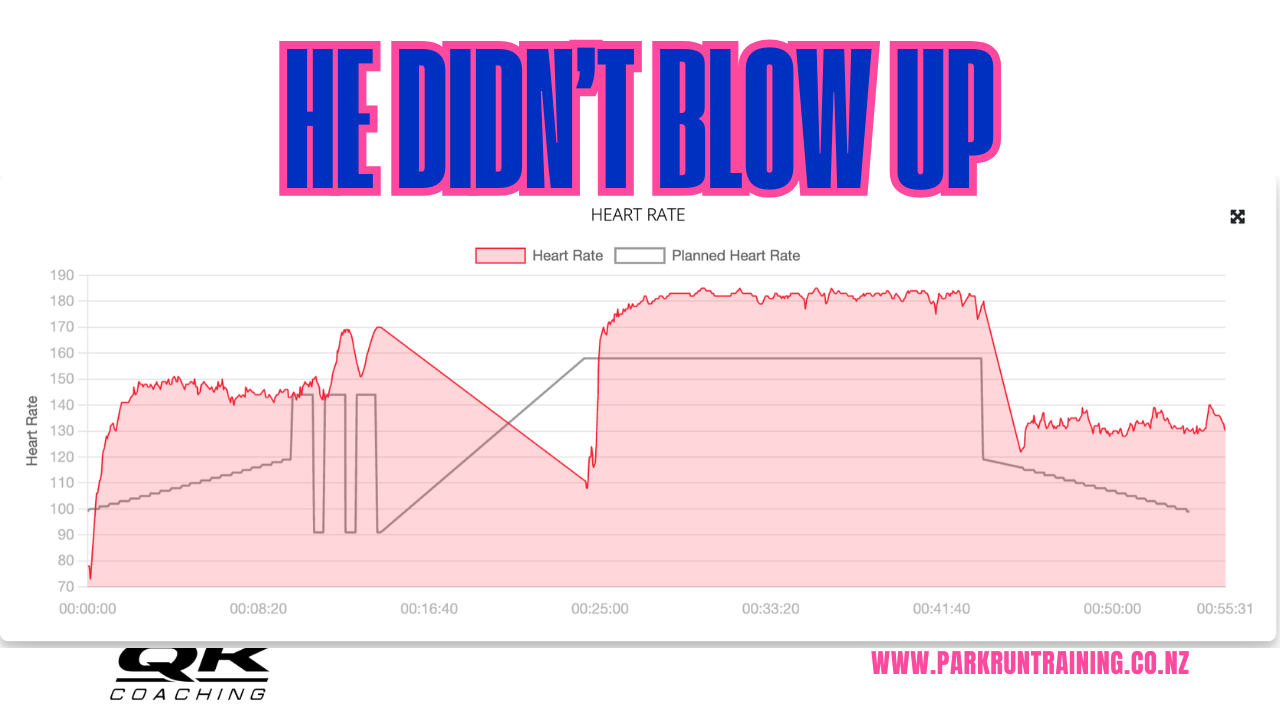
This week’s (not) parkrun Progress Report comes from Harrison Shaw, who completed a 5K time trial on 1 June 2026 in a very impressive 19:03.
Interestingly, Harrison wasn’t particularly happy with the result.
But when I looked at the data, I came away with a very different conclusion.
Because this wasn’t just a fast 5K.
It was a very well-executed 5K.
And the most impressive part of the run wasn’t the opening kilometre.
It was what happened afterwards.
The opening kilometre grabs your attention
Splits:
- 1st Km – 3:37
- 2nd Km – 3:48
- 3rd Km – 3:52
- 4th Km – 3:53
- 5th Km – 3:53
That first kilometre immediately jumps off the page.
A 3:37 opening kilometre projects toward something much closer to an 18-minute performance than a 19-minute one.
When I see a first kilometre that fast, I normally expect one of two things:
- a major blow-up
- or a significant fade through the middle kilometres
Neither happened.
The fade was remarkably small
Let’s put this into perspective.
After opening in 3:37:
- the 2nd kilometre slowed by 11 seconds
- the 3rd kilometre slowed by another 4 seconds
Then Harrison effectively locked onto pace:
- 3:52
- 3:53
- 3:53
That’s excellent pacing.
In fact, I wouldn’t even describe it as damage control.
I’d describe it as:
finding sustainable race pace after an enthusiastic start.
Once Harrison settled into the effort, he held it exceptionally well.
This was a genuine race effort
Average heart rate by kilometre:
- 173 bpm
- 183 bpm
- 182 bpm
- 182 bpm
- 181 bpm
This is exactly what we’d expect from a hard 5K effort.
The first kilometre heart rate is lower because heart rate always lags behind effort.
What matters is what happened afterwards.
Once the heart rate climbed into the low 180s:
- it stayed there
- it didn’t collapse
- it didn’t drift down
That tells us Harrison was operating very close to his limit for the final four kilometres.
This wasn’t a pacing issue.
This was a properly committed race effort.
The cadence data is one of the biggest positives
Cadence:
- 92
- 91
- 91
- 90
- 90
Honestly, this might be the most impressive metric of the entire run.
Because despite:
- a very fast opening kilometre
- accumulating fatigue
- and a sustained high heart rate
his mechanics stayed remarkably consistent.
Many runners who start too fast show:
- cadence collapse
- over-striding
- loss of rhythm
Harrison didn’t.
The drop from 92 to 90 strides per minute is minimal and likely not meaningful.
This is the profile of a runner who stayed mechanically efficient throughout the effort.
The terrain wasn’t driving the result
Elevation changes throughout the run were small:
- 5m gain
- 1m gain / 1m loss
- 2m loss
- 1m gain / 5m loss
- 3m gain / 3m loss
Nothing significant.
This means the pacing pattern was largely physiological rather than terrain-driven.
The course wasn’t making the decisions.
Harrison was.
The biggest positive
The thing I like most about this run isn’t the 3:37 opening kilometre.
It’s what happened immediately afterwards.
A lot of runners mentally unravel when they realise they’ve started too quickly.
They panic.
They focus on the mistake.
They stop racing.
Harrison did none of that.
Instead he:
- adjusted
- settled
- accepted the correction
- and got on with the job
That’s a sign of racing maturity.
Where is the opportunity?
Ironically, the biggest opportunity may sit in the first kilometre.
If Harrison opens slightly more conservatively:
- 3:42
- 3:43
- 3:44
rather than 3:37
he may arrive at the final kilometre with just a little more left to give.
That doesn’t necessarily require more fitness.
It simply requires slightly better distribution of effort.
And that could potentially be the difference between:
19:03
and
sub-19.
What this run really tells us
Many runners focus exclusively on the finishing time.
But the data tells a deeper story.
This wasn’t a runner who blew up and survived.
This was a runner who:
- started ambitiously
- adapted intelligently
- maintained excellent mechanics
- and stayed committed all the way to the finish
That’s a very different performance profile.
And it’s one that often points toward faster times in the future.
The key takeaway
The most impressive part of this run wasn’t the 3:37 opening kilometre — it was Harrison’s ability to settle down, lock onto pace, and keep fighting all the way to the finish.
That’s often what separates a good 5K from a great one.
Want help improving your own parkrun pacing?
If you’d like help pacing smarter, racing more consistently, and understanding exactly where your next gains can come from, parkrun Kickstart is designed specifically for recreational runners wanting to improve over 5K.
👉 Join parkrun Kickstart here:
https://www.coachraytraining.co.nz/signup/parkrun-kickstart
And if you’d like your own run analysed in a future parkrun Progress Report:
👉 Apply here:
https://qwik-kiwi.kit.com/parkrun_progress_report
Ka kite anō — and all the best for your next parkrun.