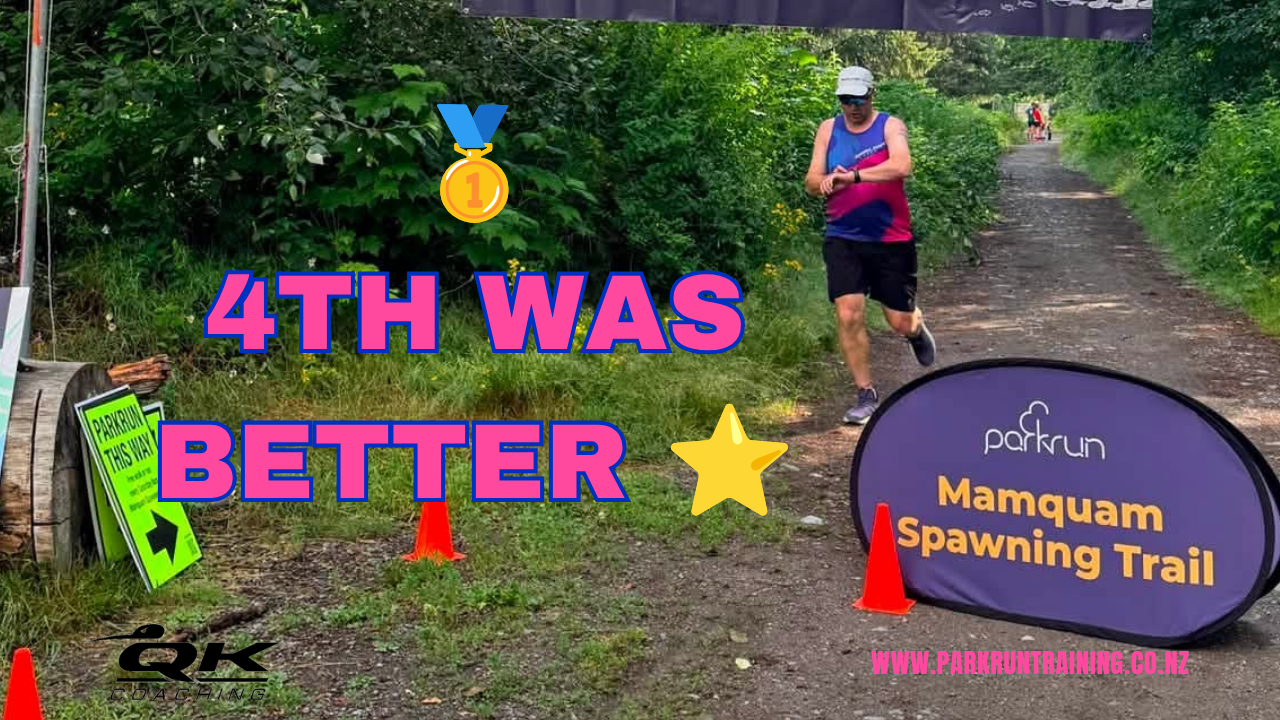
Two weeks earlier, I stood on top of the podium.
This time I crossed the finish line in fourth place.
On paper, it looked like a worse result.
In reality, I think it was the better performance.
That’s one of the reasons I love analysing data after a parkrun. Finishing position only tells you where you placed against everyone else on the day. It doesn’t necessarily tell you how well you performed.
Sometimes the biggest improvement has nothing to do with the results sheet.
It comes from executing your race exactly as you planned.
A Different Challenge
When I returned to Mamquam Spawning Trail parkrun in Squamish, British Columbia, my objective had completely changed.
Two weeks earlier I’d challenged myself to run a progressive race, getting faster with every kilometre.
This time the challenge was almost the exact opposite.
I wanted to become a metronome.
The goal was simple:
Run 4:30/km and don’t let it drift.
It sounds straightforward.
It isn’t.
Holding a constant pace outdoors—on gravel trails, with corners, other runners and changing sensations—is one of the hardest pacing skills to master. The Mamquam Spawning Trail course is a predominantly flat, double-loop gravel route alongside the Mamquam River, making it an excellent place to practise pace discipline because there are very few hills to disguise pacing errors.
The Splits Tell The Story
My target pace was:
4:30 per kilometre
The actual splits were:
- 4:30
- 4:27
- 4:29
- 4:30
- 4:29
That’s incredibly satisfying to look at.
Across the entire 5 kilometres I deviated by only a few seconds from the planned pace.
Many runners struggle to achieve that consistency even on a treadmill.
Doing it on a trail parkrun requires concentration from the first step to the last.
Compare That To Part One
The first run looked like this:
- 5:14
- 4:50
- 4:41
- 4:38
- 4:29
Every kilometre intentionally became faster.
This second run looked completely different.
Instead of gradually increasing the pace, I simply locked onto one rhythm and refused to let it wander.
Both strategies required discipline.
They just demanded different kinds of discipline.
Heart Rate Confirmed The Strategy
Average heart rate climbed like this:
- 149 bpm
- 163 bpm
- 168 bpm
- 173 bpm
- 171 bpm
The biggest difference from Part One was the opening kilometre.
Because I started immediately at race pace, heart rate climbed much earlier.
That was expected.
What impressed me was how stable everything became during the second half of the run.
The data suggests I found an effort level that was challenging but sustainable.
I wasn’t chasing runners.
I wasn’t hanging on.
I was simply holding the planned intensity.
The Power Numbers Might Be My Favourite
Average power was remarkably consistent:
- 404 W
- 398 W
- 402 W
- 398 W
- 396 W
before increasing to 412 W over the final sprint.
Only a handful of watts separated the first five kilometres.
That tells me I wasn’t surging.
I wasn’t backing off.
I was simply applying almost identical effort from beginning to end.
For a pacing-focused training exercise, that’s exactly what I was aiming for.
Consistency In The Mechanics
Cadence barely moved:
- 87
- 87
- 87
- 86
- 86
Wonderfully boring.
And that’s a compliment.
There was no scrambling late in the race.
No frantic increase in leg speed.
The running mechanics stayed almost identical throughout.
When your mechanics remain consistent, your pacing often follows.
Fourth Place Doesn’t Matter
Here’s the interesting part.
I finished fourth.
Two weeks earlier I’d won.
Does that mean I ran worse?
Not at all.
The field was much stronger.
In fact, the winning time was dramatically quicker than it had been two weeks earlier.
My placing dropped.
My performance improved.
That’s why comparing yourself with other runners can sometimes be misleading.
The better comparison is with your previous self.
And by that measure, this run represented a significant step forward.
The Bigger Lesson
Neither of these two parkruns was about running as fast as I possibly could.
Both were controlled coaching experiments.
Part One asked:
Can I execute a negative split?
Part Two asked:
Can I execute perfect pace discipline?
Both questions required completely different approaches.
Both produced valuable lessons.
And both moved me closer to future personal bests.
Precision Creates Confidence
One of the biggest benefits of pace discipline isn’t simply running faster.
It’s removing uncertainty.
When you know exactly what race pace feels like, you stop guessing.
You stop reacting emotionally.
Instead, you trust your preparation.
That confidence becomes incredibly valuable when you eventually decide to race flat out.
Final Thoughts
This run wasn’t about proving I could run 22:58.
It was about proving I could execute a plan.
Five kilometres at virtually identical pace, supported by remarkably consistent heart rate, power and cadence, demonstrated that successful racing isn’t always about pushing harder.
Sometimes it’s about becoming more precise.
And precision is a skill every parkrunner can develop.
Ready To Run Smarter?
If you’d like structured coaching designed specifically for parkrunners, parkrun Kickstart will help you improve your pacing, race execution and confidence so you can run smarter every Saturday morning.
👉 Join parkrun Kickstart today:
https://www.coachraytraining.co.nz/signup/parkrun-kickstart
If you’d like me to analyse your own parkrun or 5K in a future parkrun Progress Report, I’d love to help.
I’ll break down your pacing, heart rate, cadence, power and race execution, then show you exactly where your next personal best might be hiding.
👉 Apply for your own parkrun Progress Report: