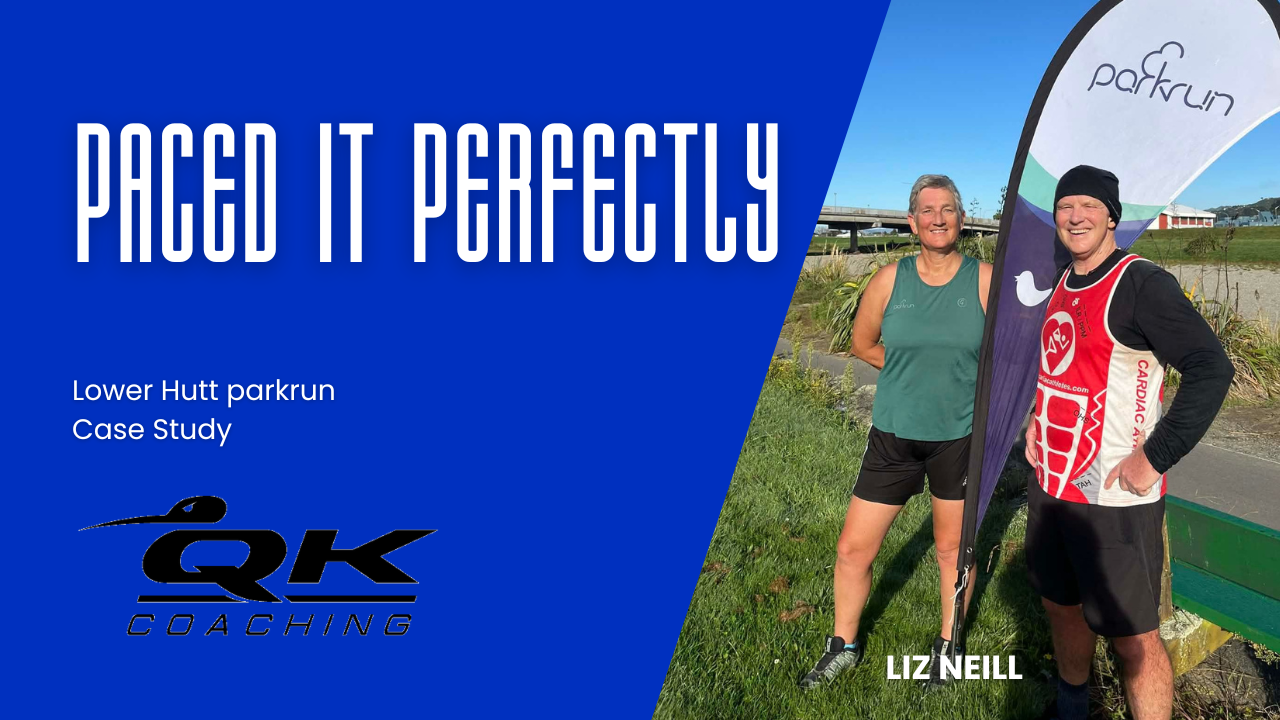
This week’s parkrun Progress Report looks at Liz Neill’s Lower Hutt parkrun from 11 April 2026, where she ran 32:37 and, just as importantly, produced the sort of pacing many runners are chasing every Saturday.
It wasn’t flashy.
There were no wild surges, no dramatic fade, no desperate final kilometre trying to rescue the run.
Instead, it was something far more valuable:
Controlled, consistent execution from start to finish.
That’s often what leads to the best long-term progress.
The run at a glance
Strava appears to have recorded the run slightly short at 4.75km, likely due to privacy settings or GPS trimming, but the split data still tells us plenty.
Splits were:
- 1st Km – 6:28
- 2nd Km – 6:31
- 3rd Km – 6:29
- 4th Km – 6:37
- Final ~750m – ~6:31 pace
That is impressively steady pacing.
There’s only a handful of seconds between the fastest and slowest kilometre. Many runners lose more than that in the opening 500 metres.
The smartest part of the run happened early
What I really like here is what didn’t happen.
Liz didn’t:
- charge the first kilometre
- get caught up in other runners
- try to bank time early
Instead, she settled immediately into an honest rhythm.
That matters because the first kilometre often decides whether the final kilometre is strong… or a struggle.
Too many runners run the opening section on emotion rather than judgment.
Liz ran this one with patience.
The heart rate story
Heart rate climbed progressively through the run:
- ~148 at 1km
- ~153 at 2km
- ~170 at 3km
- ~177 at 4km
- ~179 at the finish
That’s exactly what we want to see.
It suggests:
- effort controlled early
- gradual rise as the run develops
- commitment late when it matters most
Rather than redlining too soon, she built into the effort.
That’s smart racing.
The middle kilometres: calm and composed
The 2nd and 3rd kilometres are almost identical.
That tells us:
- no panic if pace drifted slightly
- no overreaction trying to “make up time”
- good internal awareness of effort
This is where many runners sabotage a PB attempt.
They see one split slightly slower than hoped, surge emotionally, and pay for it later.
Liz stayed composed.
The 4th Km: a natural slowdown, not a collapse
The slowest split was the 4th Km in 6:37.
That’s still only marginally slower than the rest of the run.
This is important.
There’s a big difference between:
- a natural slowing under fatigue
and - a full pacing collapse
This was the first one.
The effort remained solid, and she was still moving well.
Cadence and rhythm
Cadence sat mostly in the 168–172 range, with peaks into the mid/high 170s and even 180.
That suggests:
- stable mechanics
- decent rhythm
- no major late-race breakdown
When cadence falls apart late, pace often goes with it.
That didn’t happen here.
The Strava segment PRs matter
Liz also picked up multiple Strava personal records and strong placings on several course segments.
That usually tells us one thing:
Fitness is improving across the board — not just on one lucky day.
Strong segment performances through the middle and later parts of the course support what the split data already shows:
This was a well-run performance.
Where the next gains are hiding
The biggest opportunity now likely comes from confidence in the final stages.
Because this run was so controlled early, there may be room to:
- lift slightly from the 3rd Km onward
- attack the final kilometre more decisively
- trust that she can handle discomfort later in the run
That’s where many sub-32 or sub-30 progressions begin.
Not by running the first kilometre faster.
By racing the last two kilometres better.
The lesson for every parkrunner
If you’re trying to improve your parkrun time, this run offers a simple reminder:
Consistency beats chaos.
You don’t need heroics in the first kilometre.
You need:
- patience early
- rhythm through the middle
- courage late
That’s the formula.
Want to improve your own parkrun pacing?
If you’d like help pacing smarter, finishing stronger, and making real progress, parkrun Kickstart is built for runners just like you.
👉 Join parkrun Kickstart here:
https://www.coachraytraining.co.nz/signup/parkrun-kickstart
And if you’d like your own run analysed in a future parkrun Progress Report:
👉 Apply here:
https://qwik-kiwi.kit.com/parkrun_progress_report
Ka kite anō — and all the best for your next parkrun.