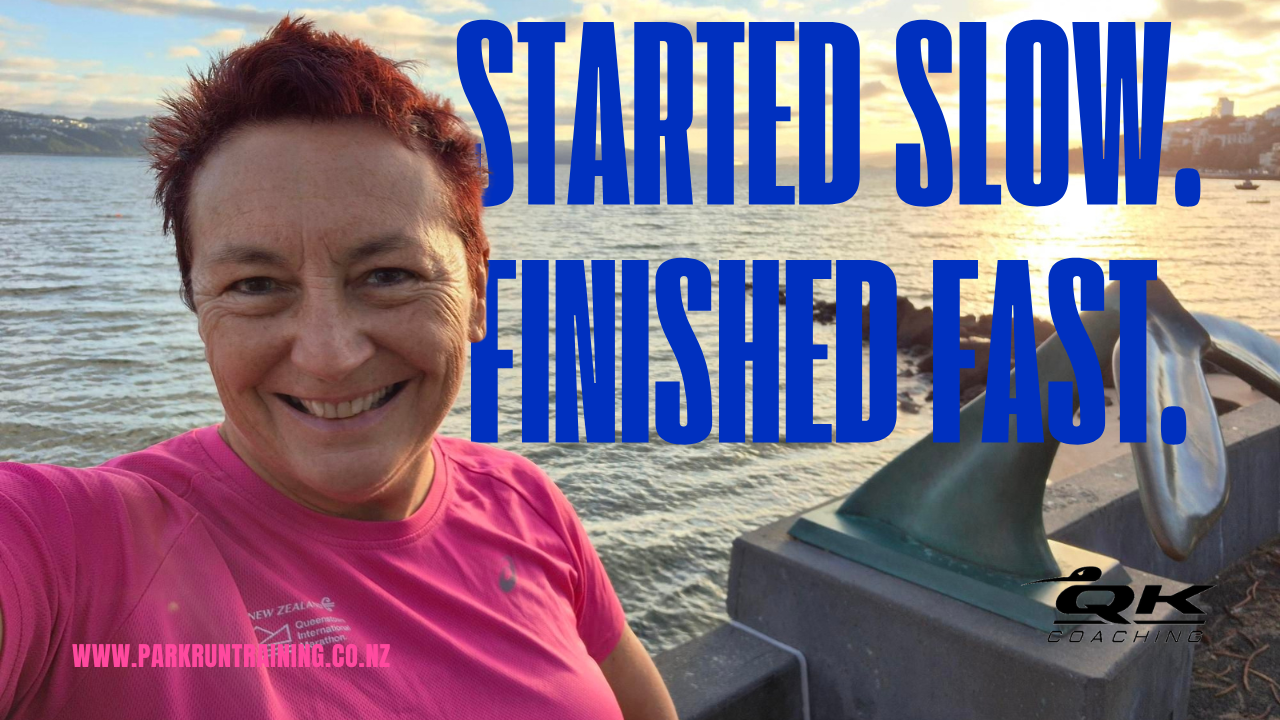
This week’s parkrun Progress Report comes from Tanya Winter and her run at Waitangi parkrun in Wellington on Anzac Day 2026, where she ran 28:16 in a field of more than 560 runners.
At first glance, the opening kilometre looks cautious.
But when you look deeper into the run, it becomes pretty clear:
That cautious start is exactly why this performance worked so well.
The run at a glance
Strava recorded the run at just over 5km, with splits of:
1st Km – 6:06
2nd Km – 5:28
3rd Km – 5:33
4th Km – 5:22
5th Km – 5:12
That’s a really nice progression.
After the opening kilometre, Tanya:
settled into rhythm
stayed controlled
and got progressively faster as the run unfolded
That’s smart pacing.
Waitangi parkrun on Anzac Day: context matters
This event had more than 560 runners.
Anyone who has run a large parkrun knows what that can mean:
congestion early
difficulty finding rhythm
weaving around people
temptation to force the pace too soon
The opening kilometre at 6:06 strongly suggests Tanya made a deliberate decision to:
stay calm
avoid fighting the crowd
and let the race come to her
Honestly, that was probably the smartest option available.
The biggest positive: she never faded
This is the standout feature of the run.
Once clear of the early congestion:
5:28
5:33
5:22
5:12
That final kilometre at 5:12 is excellent relative to the opener.
It tells us:
she still had strength late in the run.
That’s what you want from a 5K.
Why patience matters in a parkrun
A lot of runners make the mistake of panicking after a slow first kilometre.
They think:
“I’m behind pace”
“I need to make time up now”
So they surge.
And often: ➡️ burn too much energy too early ➡️ fade later in the run
Tanya didn’t do that.
She trusted the process.
And because of that, she was able to:
maintain rhythm
keep moving well
and finish stronger than many around her
Cadence tells a really good story
Even without heart rate data, cadence gives us some useful insights.
Cadence sat very consistently around:
172–176 SPM
That’s excellent stability.
It suggests:
efficient movement
good rhythm
no major breakdown under fatigue
And importantly: ➡️ cadence lifted again late in the run
That matches the stronger finish.
Only seconds away from her best
Tanya’s best parkrun this year is:
28:06 at Hamilton Lake
This run was:
28:16
Only 10 seconds slower.
But when you factor in:
the size of the field
the congestion
the cautious opening kilometre
the unfamiliar course
…it’s arguably just as strong a performance.
Possibly even smarter from an execution perspective.
What this run really shows
This wasn’t:
a runner desperately hanging on for a time.
This was:
a runner building through the event and finishing with confidence.
That’s a huge difference.
Where the next gains are
Because Tanya finished so strongly, the opportunity is pretty obvious.
Not:
a dramatically faster start
But perhaps:
getting onto rhythm slightly earlier once clear of congestion
reducing the gap created in the opening kilometre
trusting that late strength even more
That could easily bring: ➡️ another 10–20 seconds
And potentially a new PB.
The lesson for every parkrunner
Sometimes the smartest first kilometre is the one that lets you finish fastest.
Tanya’s run is a really good reminder that pacing isn’t about being aggressive early.
It’s about:
staying controlled
building rhythm
and having something left when the run gets hard
Want help with your own parkrun pacing?
If you’d like help pacing smarter, finishing stronger, and improving your confidence over 5K, parkrun Kickstart is designed to help you do exactly that.