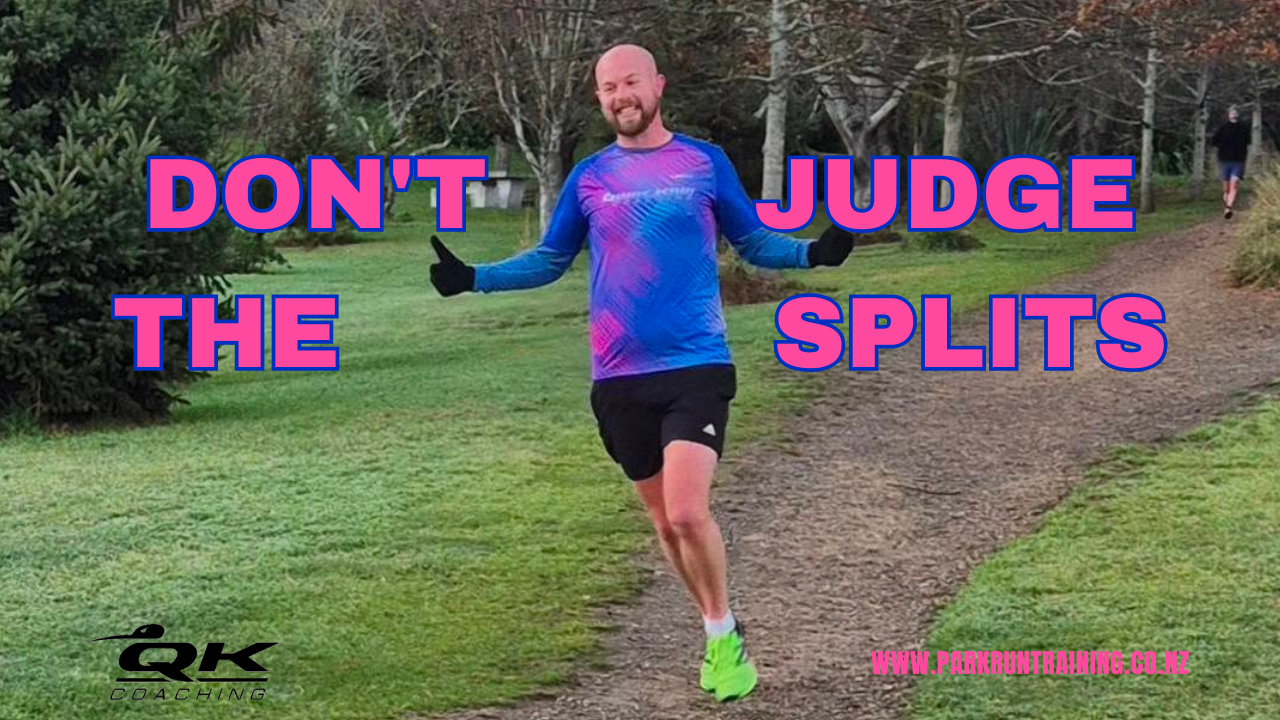
This week’s parkrun Progress Report features Jason Ford and his run at Halswell Quarry parkrun #90, where he finished in 26:39.
At first glance, Jason’s kilometre splits look like a pacing disaster.
But once you understand the course profile, the entire run tells a very different story.
This wasn’t poor pacing.
It was smart racing.
And that’s an important distinction for anyone who runs hilly parkruns.

Halswell Quarry Isn’t Your Average parkrun
Halswell Quarry has quickly earned a reputation as one of New Zealand’s most demanding parkrun courses. The two-lap route climbs to the quarry rim before descending through the Japanese Garden, accumulating around 180 metres of elevation change over 5 kilometres. It’s a course where pacing strategy needs to be based on effort rather than pace.
Trying to run every kilometre at exactly the same pace simply doesn’t work here.
The terrain decides the pace.
Your job is to manage the effort.
Jason did exactly that.
The Splits Only Tell Half The Story
Jason’s splits were:
- 1st Km – 5:55
- 2nd Km – 4:47
- 3rd Km – 4:52
- 4th Km – 6:49
- Final 970m – 4:31/km pace
If you ignored the hills, you’d probably conclude he started inconsistently and faded badly during the fourth kilometre.
That couldn’t be further from the truth.
The first kilometre included approximately 58 metres of climbing.
The fourth kilometre included another 69 metres of climbing, along with significant descending.
Those two kilometres were always going to be slower.
They weren’t mistakes.
They were simply the cost of running uphill.
Race The Terrain, Not Your Watch
One of the biggest mistakes runners make on hilly courses is trying to force their target pace on every climb.
The watch says you’re slowing down.
You panic.
You push harder.
By the time you reach the top of the hill, you’ve emptied the tank.
Jason appears to have taken a much smarter approach.
He accepted that the climbing kilometres would be slower and made the most of the faster downhill sections.
That’s racing the course instead of racing the numbers on your watch.
The Second Kilometre Shows Excellent Judgement
After working hard through the opening climb, Jason immediately produced a 4:47 second kilometre.
Yes, gravity helped.
But so did good pacing.
Had he attacked the first climb too aggressively, it’s unlikely he would have been able to capitalise on the downhill as effectively.
Instead, he still had something left to run well.
The Fourth Kilometre Isn’t A Weakness
At 6:49, the fourth kilometre immediately catches your attention.
Without context, it looks alarming.
With context, it looks perfectly reasonable.
This section contained another significant climb of around 69 metres, making it one of the toughest parts of the course.
Almost every runner slows here.
Jason did exactly what he should have done.
He respected the terrain rather than fighting it.
A Strong Finish Says Everything
Perhaps the most encouraging statistic is the finish.
Jason’s watch recorded his final 970 metres at 4:31/km pace.
After tackling another major climb, he still had enough left to accelerate strongly all the way to the line.
That tells me he judged his effort exceptionally well.
He didn’t simply survive the course.
He raced it.
The Heart Rate Supports The Story
Jason’s average heart rate by kilometre was:
- 178 bpm
- 166 bpm
- 167 bpm
- 168 bpm
- 166 bpm
Normally we’d expect heart rate to climb steadily throughout a race.
Instead, Jason’s highest average heart rate came during the opening kilometre.
On this course, that makes perfect sense.
Climbing rapidly increases cardiovascular demand, even while your pace slows.
Once Jason crested the hill and began descending, his pace increased significantly while his heart rate became more controlled.
That’s exactly what we’d expect from someone managing the terrain intelligently.
Cadence Adapted Naturally
Cadence also reflected the changing terrain.
- 86 spm
- 90 spm
- 90 spm
- 85 spm
- 92 spm
The slower cadence occurred during the steep climbing sections.
The faster cadence appeared during the descents and finishing sprint.
Importantly, there was no sign of Jason’s running mechanics breaking down.
He simply adapted his stride to suit the course.
The Biggest Lesson
The biggest takeaway isn’t Jason’s finishing time.
It’s the way he managed his effort.
Too many runners judge their performance by what their watch says during the climbs.
Jason judged his run by something much more important.
He raced the terrain.
As a result, he still had enough energy to finish strongly.
Final Thoughts
Jason’s performance is a great reminder that hilly parkruns require a different mindset.
Even pacing isn’t always good pacing.
Sometimes the smartest race strategy is to accept slower climbs, take advantage of the descents, and focus on maintaining a consistent effort rather than a consistent pace.
That’s exactly what Jason demonstrated.
On a hilly course, don’t judge your race by the pace on your watch. Judge it by how well you managed your effort from start to finish.
That’s the lesson every parkrunner can take away from this run.
Want To Improve Your Own parkrun?
If you’d like to become a stronger, smarter parkrunner, parkrun Kickstart provides structured coaching to help you pace better, build confidence, and achieve more personal bests.
👉 Join parkrun Kickstart:
https://www.coachraytraining.co.nz/signup/parkrun-kickstart
If you’d like your own parkrun or 5K analysed in a future parkrun Progress Report, you can apply here:
👉 https://qwik-kiwi.kit.com/parkrun_progress_report
Ka kite anō, and I’ll see you at your next parkrun.